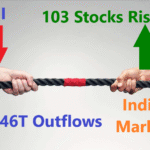

Retail Investment Flows Keep Markets Artificially Elevated, Creating Systemic Vulnerabilities
The Structural Shift in Market Risk Distribution
Over recent years, international capital has been retreating systematically. Wave after wave of foreign capital exits the Indian market. Meanwhile, company founders and their close partners strategically lighten their holdings at premium prices. Yet the market refuses to collapse. Why? Monthly systematic investment plans continue uninterrupted. Insurance companies maintain their purchasing momentum. Benchmark indices hold their ground.
This resilience deserves recognition. Mass participation from individual investors has eliminated India’s historical dependence on overseas money. The democratization of capital markets represents genuine progress. No longer can foreign fund withdrawals trigger systemic panic.
However, this achievement carries hidden dangers. The bill for this transformation is arriving now.
Risk Migration: From Capable Hands to Vulnerable Ones
Market risk has fundamentally relocated. It no longer resides with business builders who generate it, institutional investors compensated for managing it, or wealthy individuals equipped to absorb it. Instead, risk now concentrates within ordinary households never intended to function as the market’s stabilizing force.
Their automated monthly contributions operate without price consideration. Global interest rate movements? Ignored. Valuation metrics? Irrelevant. Alternative investment opportunities? Unconsidered. These investors assume portfolio managers handle those complexities.
But fund managers face an overwhelming challenge. Massive SIP inflows arrive relentlessly, forcing managers into a competitive race against peers rather than disciplined valuation-based investing. They chase trending stories across both initial public offerings and existing securities.
The Geography of Selling Pressure
Foreign institutional investor concentration reveals telling patterns. Sectors where international capital remains heavily positioned—private banking, information technology services, insurance providers, and consumer staples—experience visible and continuous selling. Prices decline measurably.
Elsewhere, damage manifests differently. Not through active selling, but through conspicuous absence. Automotive manufacturers, cement producers, metal companies, public sector undertakings, domestic cyclical businesses, telecommunications, retail chains, and small-to-mid-sized enterprises have diverged dramatically from international valuation benchmarks. The arbitrage capital that typically corrects such anomalies has vanished.
The outcome? A marketplace where global peer comparisons lose meaning. Relative valuation signals get systematically ignored. Eventually, when foreign capital returns, it won’t endorse these price levels. It will correct them. Absence merely postpones the adjustment—it doesn’t eliminate it.
When the Equilibrium Breaks
For an extended period, this arrangement functioned smoothly. Capital inflows accelerated. Corporate earnings exceeded expectations. Money rotated efficiently into mid-cap and small-cap segments. Positive developments generated positive outcomes. Foreign selling remained confined to large-cap stocks.
That balance is destabilizing now.
Liquidity no longer expands—it simply recirculates. Portfolios have reached capacity. Valuations appear stretched across all segments. Investor awareness increases. Caution spreads. Risk appetite contracts. Global capital fixates on artificial intelligence opportunities and elevated American treasury yields. Any rally triggers profit-taking. Index levels hold steady while individual portfolios deteriorate. Nothing catastrophically fails, yet nothing meaningfully succeeds.
Why Households Shouldn’t Bear This Burden
Concentrating excess market risk within households creates fundamental problems. Not because individual investors lack intelligence. Rather, because their losses carry economic consequences.
When household investment portfolios decline significantly, spending patterns shift. Consumer confidence erodes. Political sensitivity intensifies. A routine drawdown for an international fund becomes a macroeconomic concern when millions of small savers experience it simultaneously. Disappointment cuts deeper when family financial goals and life aspirations connect directly to systematic investment performance.
The Structural Advantage of Alternative Risk Bearers
Business entrepreneurs and foreign institutional investors possess different characteristics. Entrepreneurs launch ventures fully aware that invested capital might disappear. International funds anticipate volatility, implement hedging strategies, rotate positions strategically, and exit without requesting regulatory protection. They don’t participate in domestic elections. They don’t demand market stability as governmental responsibility. Structurally, they function as superior risk carriers.
Additionally, their prolonged selling weakens India’s macroeconomic fundamentals. While the dollar depreciates against other major currencies, the rupee continues weakening against the dollar. Until foreign institutional investors regain confidence in rupee stability, India will remain outside their investment consideration.
The Path to Rebalancing
How does this situation reverse course? Not through marketing campaigns or promotional presentations. Through repricing.
Valuations must compress. This happens through either outright market corrections or through earnings expansion without corresponding price appreciation. Disappointing and inconsistent returns from numerous fund managers will eventually moderate systematic investment flows.
Ironically, wealth creation will bypass those who “rescued” the market, despite their capital helping generate substantial fortunes for company founders and financial intermediaries.
Furthermore, American government bond yields need to stop competing directly with equity returns. The artificial intelligence investment theme must mature sufficiently for foreign institutional investors to broaden their focus and reconsider India. Neither factor falls within India’s direct influence.
The Uncomfortable Reality
Individual investors stabilized the market—and inadvertently inflated it. They shouldn’t be encouraged to continue this role indefinitely. Eventually, they’ll prove incapable of bearing the associated costs and consequences.
The market requires more capable hands managing risk. Current arrangements concentrate vulnerability precisely where economic and social stability matter most. Recognizing this reality represents the first step toward sustainable market structure.